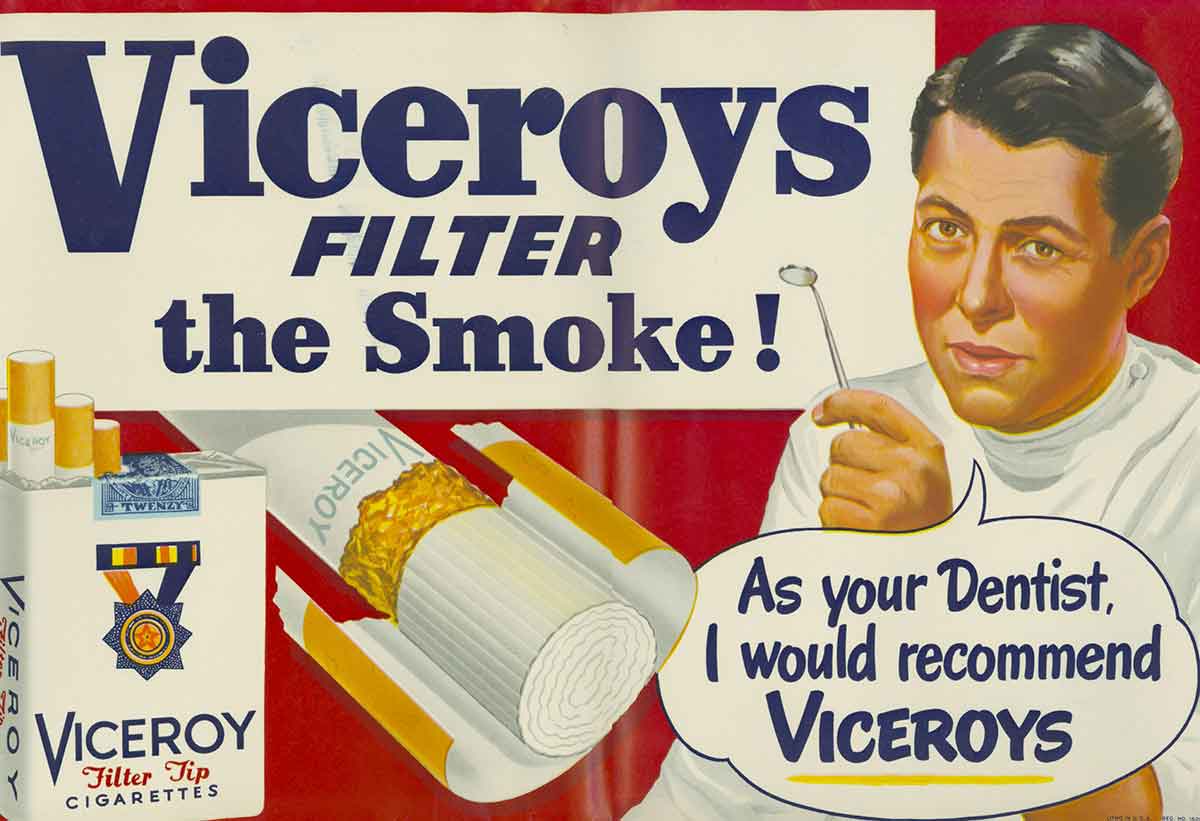
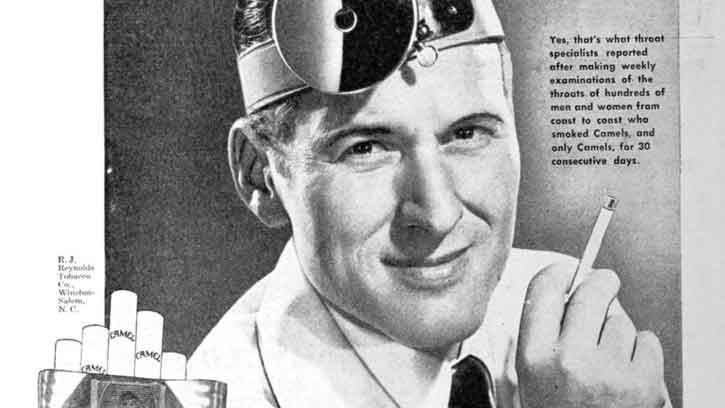
Dentists appear to be the industry’s latest target
The industry’s targeting of physicians is well documented, but only recently have we begun to see the extent to which it also targets dentists.
Research from the German Cancer Research Center and the Tobacco Control Research Group illustrates one tobacco company’s multi-pronged strategy to influence dentists in Germany, starting in 2021.
The researchers found that Philip Morris (PM) GmbH, a subsidiary of Philip Morris International (PMI), was publishing content in multiple dental magazines. The articles typically focused on the industry’s version of “tobacco harm reduction” and framed HTPs, e-cigarettes or nicotine pouches as “an opportunity for oral health.” The articles often cited the company’s own research, and sometimes did not disclose that the company itself was the creator of the content.
PM GmbH also tried to reach practitioners through sponsored continuing education opportunities. Researchers identified at least 10 webinars sponsored by PM GmbH and PMI Science, another subsidiary of PMI, on dental e-learning platforms. They covered topics such as the role of e-cigarettes and HTPs in overcoming “barriers” to quitting smoking, and whether such products are reduced-risk options. (This, despite the FDI World Dental Federation’s 2021 policy statement, which states that dental professionals should not recommend e-cigarettes or HTPs as alternatives to cigarettes, nor as cessation tools, since neither has been proven safe.)
PMI Science also partnered with Aktionsbündnis gesundes Implantat (Action Alliance Healthy Implant, a group of companies, associations, publishers and scientists supporting dental implant health, and was an exhibitor at the “Innovations Implantology” symposium, a long-running series of continuing education and professional events. Such involvement is a known industry tactic to try to normalize its presence in scientific discourse and events.
PM GmbH tried to boost its credibility further by recruiting dentists and other dental professionals to appear in its sponsored webinars.
Targeting dentists appears to be a global strategy
These tactics aren’t only being used in Germany.
Leaked documents from Philip Morris Japan (PMJ) showed the tobacco giant was strategizing to influence dentists in 2019. One presentation revealed PMJ’s strategy to create a “dentist referral program” and to run a pilot program with 15-50 dentists to promote its HTP, IQOS.
In 2021, researchers called out a PMI advertisement running in Japan Dental News. The ad cited four studies that were led by a PMI scientist and that were partially funded by the company. The messaging in the ad contains striking similarities to a tobacco industry ad targeting medical professionals that ran more than 80 years ago. Both speak directly to medical professionals in their capacity to advise patients, and directly promote industry-linked research.
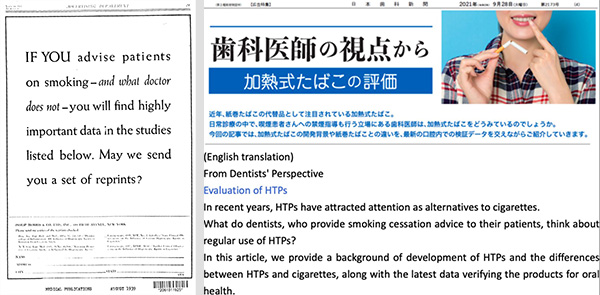
Left: Philip Morris International ad, 1939. Source.
Right: Philip Morris International ad, 2021. Source.
Further, several cases of industry attendance and presentations at dentistry and oral health conferences in Bulgaria, Canada, Italy, Japan, Serbia, the United Kingdom and the United States have been recorded since 2017.
Allies continue to create opportunities for industry-aligned messaging to reach medical professionals
While the industry funds and disseminates its own studies to try to influence science, it has also funded other organizations that, in turn, fund research—distancing and distorting the industry link. The Foundation for a Smoke-Free World was founded by PMI in 2017 and remained solely funded by the tobacco company through 2023. In 2024, the group rebranded and is now known as Global Action to End Smoking (GAES).
GAES has given grants to organizations such as Knowledge-Action-Change and the Centre of Excellence for the Acceleration of Harm Reduction (CoEHAR), both of which have funded scholarships or research relating to tobacco industry products and oral health.
Most recently, CoEHAR’s SMILE study examined the oral health outcomes of people who switched from cigarettes to the industry’s newer tobacco and nicotine products. The study involved dentists and the findings have been presented in dentistry journals.